

Just Run Lah! - Singapore's online running community | JustRunLah! - Part 208
 

5 Questions that runners are tired of answering

8
Did you win the race?
Do you ever get bored of running?
Wouldn’t you ache a lot by running so fast and/or far?

Blah blah blah!

Yes, as runners, regardless if we are amateur runners, leisure runners, seasoned runners or even, competitive runners, there are bound to be several questions that we are tired of answering to. Here, I have picked out top 5 questions that most runners might be tired of answering to.

1) Do you ever get bored of running?

Many of us assume that running is a solo sport and that he/she usually runs similar routes for each of his/ her training session. Well, these assumptions are definitely wrong. First of all, one can choose to run with a buddy (find a suitable one in which you can either pace him/her or vice versa) or with a group of enthusiastic runners by joining a running club. There are many running clubs for you to sign up nowadays like Puma Running Club, Singapore Shufflers Running Club and Team FatBird and so on. Having a running buddy or running with a group of passionate runners can give you great motivation to stay fit and to strive for longer distances or faster timings. Moreoever, with the easy and FOC access of mobile applications that are catered for runners nowadays like Map My Run, many runners are able to choose different and adventurous routes to run nowadays like Treetop Walk, Bukit Timah Nature Reserve and so on. In fact, even if one has to run the same route daily due to convenience, it would not get boring if one sets a different goal each day.

2) Do you not ache a lot when you run too much or too fast?

Well, let’s face it. Most of us do. Yet, as the saying goes, no pain no gain. No matter if you have just started a running regime, you have just got back in to your training sessions or you are pushing yourself hard to achieve something, most of us do feel the ache and sore the next day. Yet, we do not stop running because of these. In fact, we continue to push ourselves harder to achieve more. Why? One should actually feel a little sore after each training as it is kind of a gauge that one has actually pushed yourself enough and is not slacking. Of course, if the pain is an acute and persistent one, one should then consult a doctor about it.

no pain no gain

3) Did you win the race?

For runners who have joined countless marathons, you will definitely get tired of answering this question. It would be good to clarify that for many of us, joining a race might not be just about winning it. Of course, it is good to aim for that. Yet, many of us join a race for other reasons too. Some of us might join it to break our own personal record, to break our personal barriers, to stay in shape, to keep fit and healthy, to soak in the atmosphere with a buddy or two, to run in places that we do not usually get access to run in and for charitable purposes and so on. As you see, there are tons of various motivations that push us to join a race. In fact, most of the times, winning a race isn’t what that matters. It is the process of training for the race and completing it that matter most.

4) Why are you willing to pay so much for a race?

This is a question that might sound awfully familiar to many of the seasoned runners out there. In fact, it is a question that I get asked by my family and friends several times for each of the races that I have joined. For some of the runners, it can be for charitable purposes and these can be races like Run for Hope, GK Run to Build and the upcoming Metta Charity Run. Yet, for most of us, the amount that we are paying for the race do not matter. The atmosphere of a race, the friends we have made during the races, the challenge that we have posted to ourselves and have overcame- they are worth the prices we have paid for the races. Like many of the seasoned runners would have said, the experiences gained is totally worth the amount that we are paying for the races.

5) Whoa, you must be really fit and awesome in running then?

Personally, I usually give a slight smile and a ‘nah’ when people do ask me that question. Most of the times, many of us, including myself, we run to keep fit and we take it as a form of relaxation after a hectic day of work.

Thus, to assume that we are really fit and are fantastic runners because of our daily/weekly leisure runs might be a little too far- fetched.  Of course, there are times that we do get competitive and try to break our personal records with intensive training sessions. Yet, to claim that we are really fit and are awesome runners,  that would be a little too exaggerated.

So, here are the top 5 questions that in my opinion, most runners are tired of answering. To both the runners and non- runners out there, I hope this article helps you guys to understand each other more. Feel free to contribute other questions that you are tired of replying to by commenting below.
 

Running Tips for the Army Half Marathon: By Mok Ying Ren

mok ying renThe Army Half Marathon takes place on 31 August. If you have entered this, you would probably have already completed your longest run and be tapering down your training by now – to be fresh on race day.

Here are some tips from Singapore’s Mok Ying Ren, the South East Asian Games 2013 Marathon Gold Medallist, to help you out on race day. He gave these out during an Army Half Marathon training run – organised by Running Department – on National Day.

Race morning eating strategy

It is important to not eat too much on the morning of the race. Something light, such as cereals with milk is good because it does not leave you feeling bloated, but gives you just enough energy to finish the race, according to Mok, a 26-year-old Doctor (Captain) in the Singapore Army.

Do not run the race on an empty stomach because the glycogen stores in the body would have been used up during sleeping – so you need to refuel. Otherwise you won’t have energy to run.

Go at your own pace

To run a good race, it is important to go at your own pace too. Do not start out too fast at the beginning, or else you will run out of energy midway during the race. This is especially important for a long race such as a 21km one.

Break up the race into segments

It will help to break up a long race into segments so that it does not feel too monotonous. For example, a 21km run can be split up into two 5km runs and two 5.5km runs. This will help you get through the race, rather than treating it all as one super long run.

Taking energy supplements

Consuming energy chew or gels is important so that you will not run out of energy midway during the race. It is recommended to take gels every 45 minutes to 1 hour, depending on how fast you are running.

Click here for more Army Half Marathon race tips by Mok Ying Ren.

Exclusive $5 discount code for Metta Charity Run 2014

We are happy to provide our readers with a discount coupon for this year’s Metta Charity Run.

Join the run at Big Splash, East Coast Park on 6 September 2014 for a healthy morning run followed by a carnival with stalls and exciting performances put together just for you.

Register for one of the 3 categories:

  • 5km Non-competitive
  • 10km Non-competitive
  • Parent & Child 1.5km Fun Run

All readers can get $5 off the early bird price by following these steps:

1. Click here to register.

2. Choose category “Just Run Lah!

3. Enter code JUSTRUNLAH

4. Complete the rest of your details

5. Prepare your running gear and enjoy this fun and meaningful event at a discounted price!

Registration fees after applying the coupon come to only $25 and $35 for the 5km and 10km respectively.

* Coupon is valid until 17th August 2014, 23.59pm.

ParkRun comes to Singapore

0

Finally, the global running phenomenon parkrun has arrived in Singapore.

Actually it arrived in June, but I didn’t notice until last week!

So what is parkrun?

On their website (www.parkrun.com), the lovely parkrun people say :

We had an idea. We ran with it.

Parkrun started back in 2004 when 13 runners got together on a blustery day in Bushy Park, Teddington, UK. We’re now an international FAMILY of over half a million runners (and counting).

We organise free weekly timed runs all over the world. Held in pleasant parkland on weekend mornings, our runs are open to all – from juniors and first timers to Olympians and octogenarians…

And it really is this simple : Register an account, print a little barcode – and remember to take it with you.


Parkrun_32


I started running parkruns in the UK about 4 years ago – they are always 5k, and there are plenty to chose from in the UK (and Australia – where its also very popular), but now we have a parkrun in Singapore – in East Coast Park (where else 🙂 ! )

Now, every saturday morning, at 0700, you can do a 5k race, for free, with a very simple one time registration process – no pack collections, no pre organisation or planning, justrunlah !

All you need to know is here: www.parkrun.com.au/eastcoastpark/

So I decided to get out and set down a 5k time on National Day. I took the other members of my unofficial running club, The Mount Sinai Striders – this time there were 7 of us , since it’s a new idea, it’s still a quite small crowd – with our posse there were about 35 people in total (below).

It’s a straight out and back course, very busy in the park yesterday morning, but still plenty of room for our race and all the other park users – I love the simplicity of the whole event – a few marshalls, a couple of cones to indicate the finish line and that’s it. Self sufficient running at its best.

And it was an even better morning for me, because I managed to run my first sub 20 minute 5k since 2005 🙂

Most of the parkrun gang headed off to East Coast Starbucks for a quick chat and a coffee – very cool and relaxed gang – just like my experiences of parkrun in other places.

This run is perfect for runners at all levels – if you are a serious runner, it’s a great speed endurance/race practice event, if you are a new runner it’s a great confidence builder and if you are inbetween it’s a great way to experiment with pacing in a low key event.

I love it. I hope to see some more JustRunLah! folks there soon!


How are marathons and other long-distance race courses measured

1

A requirement for precision!

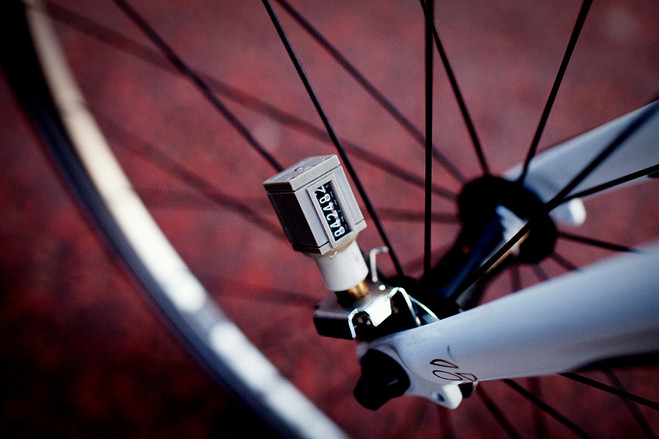
Have you ever wondered how a distance as long as 42.195km can can be precisely measured and validated down to its last meter? IAAF (International Association of Athletics Federations) has adopted the calibrated bicycle method as the only approved method for measuring road races. In this method, a simple geared device known as The Jones Counter, which counts the revolutions of a bicycle wheel is used.  The measuring procedure is outlined below.

Measurement procedures

A Jones Counter  is mounted at the hub of the bicycle’s front wheel. It is important to understand that this device does not measure distance directly. It measures the revolutions and part- revolutions of the bicycle (front) wheel. Current models of the Jones Counter have a gearing through which they register 260/11 counts (23.6363) for each revolution of the wheel. Because the circumference of bicycle wheels normally used in measurement is about 2.1m, this means that each count represents approximately 9cm on the ground.

jones counter
The Jones Counter (shown above) fixed on a bicycle is used to measure marathons and long distance running events.

The basis of the method of measurement is to compare the number of revolutions of the bicycle wheel (recorded in ‘counts’) needed to cover the race course with the number of revolutions needed to cover a standard ‘calibration course’ of known length.

The following eight steps are necessary to measure a road race course:

1. Define the road race course.

The road race course is the route to be taken by participants in the event. Defining the course is the most important step in measuring a road race course because the measurement is irrelevant if participants in the event follow a different route.

2. Select and measure a calibration course.

A calibration course is an accurately measured base line used to calibrate the bicycle. It will be straight, paved, level and on a lightly-travelled section of road, free of parked vehicles. It should be at least 300m in length, and a length of 500m is recommended. For every one road race course measure, the calibration course must be covered eight times (four times before the measurement and four times afterwards), and in both directions.The standard method of measuring a calibration course is with a steel tape. Any steel tape may be used but to be confident of accuracy use a tape made by a well-known manufacturer of surveying and construction equipment, with temperature and tension specifications (usually 20C, 50N) printed on the blade of the tape. The tape must be at least 30m long.

Calibration course
Calibration course

3. Calibrate the bicycle on the calibration course.

The aim in calibrating the bicycle before doing the road race course measurement is to calculate the number of counts registered on the Jones counter for every kilometre ridden on the bike. This figure is called the working constant.

4. Measure the road race course.

Measurement begins at either starting point or finishing line, depending on which one is fixed by the organiser. It is important to ride the shortest possible route (see below), ensuring that all runners will run at least the declared race distance.

5. Re-calibrate the bicycle on the calibration course.

The aim in re-calibrating the bicycle after the measurement is to check whether there has been any change in the number of revolutions and part-revolutions of the bicycle wheel which correspond to the length of the calibration course during the measurement of the road race course. This is to be expected, mainly due to temperature variations. If the temperature has increased, the calibration constant will be smaller. A slightly larger calibration constant may result when the temperature has dropped. Unexpected change could indicate that there is some other reason for it, such as a slow puncture of the tyre. It is best to complete the post-measurement calibration as soon after the measurement as possible, before there is time for conditions to change. Repeat the steps as in the pre-measurement calibration. Again, four rides are required for the post- measurement calibration. The average post-measurement count obtained (step 8) should be divided by the length of the calibration course in kilometres (step 9) and multiplied by 1.001 (step 10) to obtain the finish constant.

6. Calculate the length of the road race course.

To calculate the length of the road race course, you must first calculate the Constant for the Day. This is the average of the working constant and finish constant. Calculate it by adding those constants and dividing by two. The next step is to calculate the total number of counts recorded in riding the shortest possible route between the start and finish along the prescribed race route. This figure is then divided by the constant for the day. The result obtained is the length of the road race course.

7. Make final adjustments to the road race course.

It it likely that it will be needed to add or subtract some distance to make the road race course the desired length. Depending on the configuration of the race course, adjustments can be made at the start, at the finish, or at a turnaround point. If more radical adjustments are required, like re-routing along different roads, then these will have to be done using the calibrated bicycle.

8. Document the measurement.

The documentation must be sufficient to allow the course to be checked in the event of a re-measurement being required (as mandated, for example, after a world best performance has been set). Paint on the road is not enough. Within the documentation the organiser must include a map of the road race course which is clear enough to allow the race director to re-establish the course even if the roads were re-surfaced.

[wp_ad_camp_4]


The shortest possible route

The road race course is defined by the shortest possible route (SPR) that a runner could take without being disqualified. Any particular runner is most unlikely to follow the shortest possible route, just as a track runner cannot always hold the inside kerb for the length of the race, but must move out in order to overtake other runners.

The actual path of any given runner is irrelevant. The shortest possible route is theoretically well-defined and unambiguous. Defining a road race course in this way ensures that all runners will run at least the declared race distance.

Imagine how a stretched string would fit within the boundaries of the course. Follow that imaginary string when you measure. Runners may swing wide to take corners but do not attempt to measure what you think they will do. The exact SPR is the proper route to follow. Measuring the SPR means hugging the inside edges of bends. The path you should attempt to measure officially lies 30cm from the kerb or other solid boundaries to the running surface. Attempt to maintain this distance on bends and at corners. On stretches between bends the SPR takes the shortest possible straight path. It will cross from one side of the road to the other, whenever necessary, to minimise the distance. The shortest possible route in various different road configurations is shown below:

Shortest Possible Route examples


A measured course map. The Bermuda 10k.

Race Review: Tri Factor Run 2014

4

Cool crisp air, lush greenery, breathtaking scenery.

It was hard to deny that the organisers for TriFactor Run this year has indeed picked a paradise for our race participants to enjoy the race.

Breathtaking scenery

Before the sun has peered out from the clouds, the 31.5km and 21km runners have already started their races and were drenched in their perspiration. As the pathways were still pretty dark, road marshals can be seen cycling around with big headlights situated at the front of their bikes, to make sure that no one is lost during the race itself and also, to ensure the safety of the runners.  The emcee and the DJ were already cooking up the atmosphere when I reached there whilst many runners were busy doing their warm-up exercises and taking pictures of the picturesque scenery that Punggol Waterway provides us with. It was nice of the emcee to remind us of race etiquettes like, keep to the left if you are a slow runner, since it is something that is usually left unobserved in many races that I have participated.

At 7.30 am sharp, the race horn sounded. As this is a competitive race in which many seasoned marathon and even, triathlon participants do join, it was inevitable for me to feel the competitiveness of the race right at the start of it. I had to run at a faster pace than my usual pace to feel that I am not obstructing anyone’s progress.

A few sections of the race routes were pretty narrow, eg, at the start of the race ( the Nature Cove area) . Yet, this was compensated by the charming scenery that Punggol Waterway provides us with- a perfect illustration of Singapore’s progress together with Singapore’s reputation as a “Garden City”. The construction of several HDB flats (and the upcoming Punggol Safra Club) were complemented by the wide variety of flora and fauna in the park itself. Not to forget, we get to run along 2 of the bridges that allowed us to indulge ourselves in a better view of the surroundings of the park. Besides that, the routes had clear signages – how far we have ran (for all of the race categories) and which way to turn to.  In fact, there was also plenty of water stations (about 1 for every 2 to 3km), road marshals and not forgetting, medics.

Yet, due to my experiences in joining races, it is hard to not notice the areas of improvement that the organisers for the race can pay attention to.

First of all, the location of the race was pretty inconvenient. In order to get there on time, I believed many of us who do not drive depended on cabs. It would be great if shuttlebuses are provided. Moreover, I believed that for the 31.5km and 21km runners, it was pretty tiresome and boring to run around the same route thrice/ twice respectively. Besides, the ending section of the race route was pretty narrow, causing it hard for us to sprint and overtake other runners. Also, there was little restrooms along the race route.

However, with such awesome scenery and the opportunity given to run in a location that many races have not tried hosting before, the ‘complaints’ I have for this race will not deter me from participating in it again. As for sports- lovers out there who prefer competitive cycling or swimming, you will be elated to know that the Tri factor series caters for you too. So watch out for the Tri Factor series next year and be a part of one of the most popular races in Singapore!

Tri Factor Medal (10.5km)

The Great Eastern Women’s Run 2014: Run To Live Great Programme

The Great Eastern Women’s Run 2014: Run To Live Great Programme

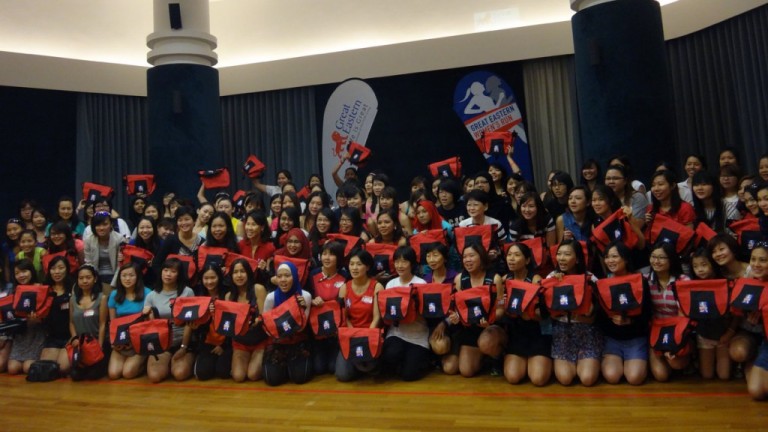
During last weekend, the Run To Live Great programme kicked off. This event, targeted at new runners, is aimed at helping them to take the first step towards a healthier lifestyle of regular exercise and staying fit.

This programme is part of the Great Eastern Women’ Run, which is taking place on 9 November this year and comprises of three categories – the 5km Fun Run, and the 10km and 21km Competitive races. It is organised by HiVelocity Events.

50 pairs of women were chosen from 500 entries

For the Run to Live Great programme, 50 pairs of women were chosen from about 500 entries. They were required to write a 100-word essay on why they deserved to be picked for the programme.

Received a $350 goodie bag

The participants all received a $350 goodie bag, comprising of items such as a pair of New Balance shoes and a Polar Loop activity tracker – to kick-start them on their new running hobby.

One of the women was 23-year-old advertising executive Vivian Sng, who has hated running ever since she was a little girl.

So by taking part in the Run To Live Great programme, she will be overcoming a huge physical and mental hurdle. She is hoping to complete the 5km Fun Run in one piece and without stopping to walk.

Participants treated to a variety of activities and tips

The Run To Live Great programme participants were treated to a variety of activities, including icebreaker games to get to know their fellow programme participants better – last Saturday.

As well, they got tips from Adrian Mok, the founder of HiVelocity, who also shared some insights with runners on the Polar Loop Activity Tracker.

They also got to ask some of Singapore’s leading experts and influencers in the running, health and fitness field, such as Mok Ying Rong, Dipna Lim-Prasad, Liv Lo and Claire Jedrek – questions on running.

Throughout the programme, the participants will be taking part in a myriad of other activities, including kickboxing and fun runs, to prepare them for race day.

Informative session for the participants

So it was definitely an informative session – which the participants thoroughly enjoyed.

Click here to read more about the Run To Live Great welcome session.

Singapore’s Oldest Marathoner: Chan Meng Hui

0

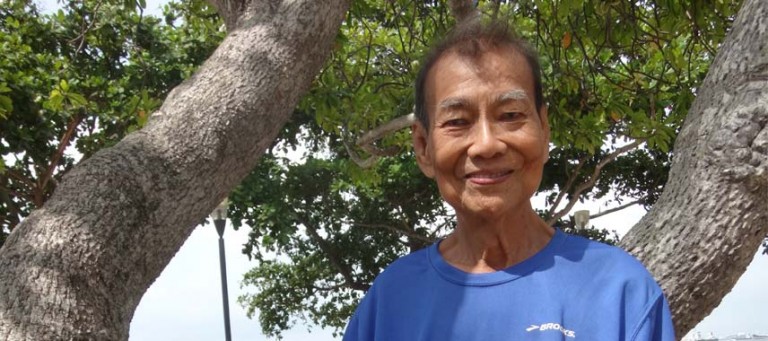
Chan Meng Hui singapore marathonChan Meng Hui, aged 84, is Singapore’s oldest marathon runner.

But Chan, who picked up running in his fifties – when he retired – is still going strong and has completed 99 marathons and still counting.

He has even written a book, Run For Life, and was promoting it at last weekend’s Run for Life event. While there, he also completed a 10km run with a finishing time of 1 hour and 45 minutes. This is admirable, considering his age.

With his book, Chan hopes to inspire other runners with his life story and how he managed to turn over a new leaf, from a party-boy to an avid athlete.

Picked up running after he retired

Chan actually used to be actively playing sports such as badminton in his teenage days, but due to his busy workload as a sales representative, he gave this up – and began indulging himself in late night partying, smoking and drinking.

But when he retired, he picked up sports again and chose running because of its ease, simplicity and convenience. This was because he realised that he was doing his health long-term damage and wanted to set things right again.

100th Marathon at the end of this year

Chan’s 100th marathon will be the StanChart marathon, taking place on 7 December this year. This will mark a personal milestone in his life.

For this run, Chan hopes to complete it in a good timing, so he is now training hard and building up mileage, from 50km to about 80km per week. His time target for the race is less than eight hours – which will be remarkable for someone of his age, should he achieve this.

Click here for more about Chan Meng Hui’s book and his marathon career.

Click here for Chan Meng Hui’s inspirational life story.

Signing up for my first Triathlon

8

The big decision

Well, I did it! I signed up for the very first triathlon of my life! I’ve done a biathlon before, so swimming 1.5km in open water and running 10km is not a problem to me. Riding a bike for 36km is the issue – I’m sure my legs will be wobbly after the swim and bike…. My friend is kind enough to lend me his bike for training and for the race, so now I’m clocking up the mileage and doing combo routines in preparation of the race on 17th Aug. It’s going to be a tough test for me, I certainly want to train for it, and enjoy the 3.5 hour ‘torture’ that I’m going to put myself through….

Well, at 45 years of age, doing my first triathlon, I think I am damn brave….. wish me luck!

Race Review: GK Run to Build 2014

“One World, One Race, One Goal”.

Picturesque scenery that Bedok Reservoir Park entails

This was the statement for GK Run to Build Race 2014, that was held last Sunday. Indeed, throughout the race itself, I can see the statement being brought to life through the race participants- for both 8.6km and 4.3km,  themselves. It was one of the races that I have participated so far that has more foreign participants (mainly Philippinos and Caucasians) than local participants. Yet, who cares when all of us are striving towards the same goal- to complete the race and to do some charity with the race fees that we have contributed.  Like what GK(Gawad Kalinga) says, we were all there “to give care”.

Reaching at Bedok Reservoir Park at 7.10am, I was surprised that there were not as many participants as I thought there would be. The starting pen was narrow and yet, there were still plenty of spaces for me to do some stretching exercises. The host was busy briefing us on what the organiser- GK1 World, does, before the race starts. GK1 World aims for poverty eradication and community building in many parts of the world- mainly Asia, and it has gathered support from different sectors in Philippines itself.  Its vision is to build ” a nation empowered by people with passion, faith and patrioticism” and yes, I can definitely see this spirit in the race participants throughout the race.

At 7. 15am sharp, the race horn for the 4.3km race sounded and we dashed across the starting line.  Across the reservoir itself and at a distance, I could already spot some 8.6km runners who were already half way through the race.  That acts as a motivation for me to run even faster and to catch up with them. In addition, since Bedok Reservoir Park is a park that is famous amongst runners, it has wide- enough paths for us to overtake other runners if we want to.

Unfortunately, my level of motivation went down a little after 2.5km due to the number of runners who were walking. Despite knowing that this is a non- competitive run, the number of runners who decided to brisk walk or stroll was pretty astounding. Though it was only a distance of 4.3km, it was hard to run with enthusiasm when you see that many people walking or stopped running half way through the run. It became more like a usual training session to me then as eventually, my only motivation for the run was to surpass my personal timing for a round around the reservoir.

Yet, despite such a disappointment, I was glad that there were ample water stations for both the 8.6km and 4.3km runners. Water stations were spotted at the 2km and 3.5km points around the reservoir. Sadly, no isotonic drinks was given even at the finishing point.  In addition, there was no clear starting and finishing points so it was hard to gauge if you are planning to sprint near the finishing point. There were only road marshalls (volunteers) to guide you along the way.

However, all these were made up with the picturesque and breathtaking scenery that Bedok Reservoir Park provides us with. Many runners stopped to take pictures with the rising sun, the glistening reservoir and the lush greenery.It was also refreshing for many runners to see how packed and lively Bedok Reservoir Park is with groups of elderly doing exercises on their mats whilst families who live nearby were doing their Sunday morning runs.

Overall, if given a chance to join this again, I will do it for charity’s sake. The lack of clear starting and finishing points, lack of enthusiasm that the host and the runners expressed, and, my preferrence for competitive runs with individual timing chips deterred me from joining this run again if it isn’t for charity. Yet, I have to mention that many of them did push themselves to at least complete the race and ran for the last 100m or so.

Race Review: Mizuno PAssion Wave Run 2014

A hot Sunday morning in July. Clear skies and full hearts. The buzz of nervous energy on the start line.

Mizuno PAssion Wave Run 2014. 15k on what I know is going to be a tough course. One steep climb & a trail section.

This is a great race though. A proper ‘old school’ runners race, not a glitzy marina bay fun run. I’m not really that bothered about the runners entitlement, but it seemed to be a pretty good deal there too, a good quality Mizuno vest and a Mizuno kit bag plus a chunky nicely engraved medal. I can’t remember how much I paid to enter, but it wasn’t one of the more expensive entries.

Race HQ in a car park at Bukit Merah View. Super friendly and helpful race volunteers everywhere, bag drop at the HDB block was well organised and efficient. Since I live quite nearby it was also super convenient!

Time to flag off!

Flag off at 0730 after the usual important person welcome. It’s a quick downhill start to get the heart pumping.

After 3k, Telok Blangah hill climb from Henderson Road – up the steps, to the top level, round the park and back down again. Lungs and Quads screaming, but recovering quickly with the long downhill section.

10569029_10204432994175871_2537394454495294137_n

An undulating section along Depot Road then down onto the Green Corridor for 3k back to Tiong Bahru. 11k in now, 4k to go, keep pushing. One more loop over the AYE and up to Tiong Bahru park, then back thorough to Bukit Merah and the finish line. I was in good shape up to about 12-13k then lost a little focus and probably dropped about 30-40 seconds over the last 2k’s.

More super helpful and friendly volunteers at the finish line. A medal, a can of pocari sweat and a banana were all handed to me within 30 seconds of finishing  🙂

Nice Mizuno Picture Booth for a photo with my running buddy then a lovely chat with the Aunties at the bag drop before an ice cold 100PLUS (100 plus in a cup with ice is officially my favorite drink EVER) at the hawker across the road.

Remembered there was a vet category and prizes for first 5 in each cat, so I went back to check, only to find out I was 6th Male Vet – just missing out on a $100 mizuno voucher by about a minute 🙁   next time!!!

All in all this is a great great race and definitely in my Singapore Top 3. I’ll be back next year.

Next up the Orange Ribbon Run, see you then guys

.10404401_789828977704547_2312846912572430200_n


Cover photo credit: Running Shots (www.facebook.com/runningshots.sg)

One Family, One Run: RunNUS 2014

NUS’ annual largest running event will be back for the 8th time on 24th August 2014. This year, new elements have been added to the event! Continue reading to find out about the Carnival and the unique Family Challenge race.

RunNUS2014_Logo_MainWhat is RunNUS?

Now in its eighth year, RunNUS is the largest and the most anticipated annual running event for NUS alumni, students and staff. Organised by the NUS Students’ Sports Club, the event is open not only to members of NUS but to the public as well.

Every year, RunNUS supports the NUS Annual Giving campaign, an annual campaign that aims to raise funds for student support. Net proceeds from runners’ fees, and individual pledges support University-wide bursaries for NUS students in financial need. For more information on the NUS Annual Giving campaign, visit www.annualgiving.nus.edu.sg.

The carnival

A new highlight for this year’s RunNUS would be the carnival to be held alongside the main running events. Participants are encouraged to attend the event with their families and soak in the joyous atmosphere with top NUS bands performing and various other exciting carnival activities and games.

The races

But that’s not all! There is a brand new Family Challenge segment for parents to bond with their kids over our specially crafted programmes.

10KM Competitive

Whether a dedicated runner or not, the 10KM Competitive Run is open to all! Push your limits to finish the route in the fastest time, or take a slow jog and enjoy the scenery. Yes, that’s right – we have a unique NUS-only scenic route, exclusive only to RunNUS. Top runners in the 10KM Competitive will walk away with attractive prizes!

5KM Fun Run

Looking to kickstart your running career or your healthy lifestyle? The 5KM Fun Run is designed just for you. It is an ideal training distance for beginners and veterans alike. Bring your friends along too, and get them to start running!

Family Challenge

Running too easy for you? Come take part in our Family Challenge and challenge your limits! Not because it’s challenging, but because you can’t do it alone. For all the fathers and mothers, your children are welcome to take part. For everyone else, bring your friends and family along and enjoy the bond of family and friendship. Challenge your family and friends to find the 3 checkpoints found around NUS and race back to the finish in the shortest time possible. The Best Dressed Family/Team will also stand to win attractive prizes!

runnus 2014 Category Price

For more information and registration, check out the official website: http://runnus.nussportsclub.org

SMU Mile Run with 10% Discount for Just Run Lah! readers

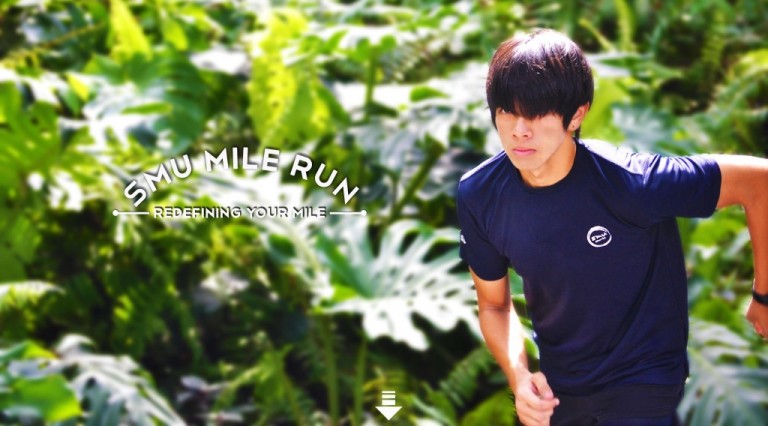
SMU Mile Run is a competitive 4.8km race organized by SMU Runteam on 21st September 2014. It aims to create a fresh running experience for the community, trigger the passion for running in Singapore, unite running enthusiasts and create awareness for Singapore’s heritage. Bringing to you an exciting and exhilarating running experience through the infusion of a unique race route.

Held in Fort Canning Park (FCP), SMU Mile Run allows you to discover a different side of FCP. Unravel the beauty of the park by traveling the path less traveled and challenge yourself as you overcome the various “ups and downs” within the park.

[ot-video type=”youtube” url=”http://www.youtube.com/watch?v=GLQYIV4oPdQ”]


10% Discount Code

Just Run Lah! is happy to present its readers with a 10% discount code (valid until 17th Aug 2014).

Just use code SMUMRJRL2014 during registration to get the special discount!


Runner’s Entitlement:

  • Exclusive SMU Mile Run 2014’s Race Shirt
  • Exclusive SMU Mile Run Race Pack
  • SMU Mile Run 2014’s Finisher Medal (Upon completion of the Race)

SMU Mile Run 2014 event t-shirt by AM.

Soh Rui Yong: The record-holder for 10km

0

A 41-Year-Old National Record Broken

Last month, a 41-year-old national running record was broken.

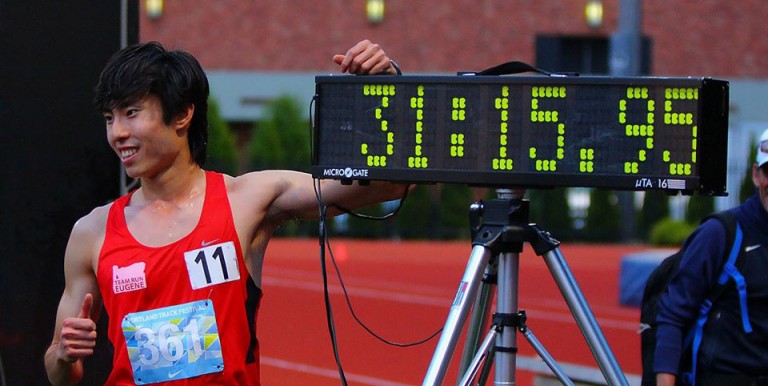
This was the 10,000m track record set by PC Suppiah in 1973 – with a time of 31 minutes and 19.0 seconds. But Soh Rui Yong, recently broke it, by running the same distance at the USA’s Portland Track and Field Festival – in 31 minutes and 15.95 seconds.

Training for the race

To train for the race, Soh, a student currently based in the USA, gradually increased his total mileage and clocked up his runs on a mixture of trail, road and track. This is because running on the same surface puts too much pressure on the joints, thus increasing the risk of injuries, according to the runner.

Confident of breaking the record

Soh, 22, had been quite confident that he could break the record. This was because he had done plenty of training. Despite being injured in the lead-up to race day, he still felt that a good run would bring him under the mark and get him the record.

Soh’s Race Strategy

To put it in a nutshell, Soh’s race strategy was to run 75 seconds per lap consistently throughout the whole race.

But it was made more difficult, by the fact that he had to pace himself.

Most challenging part of the race

The most challenging part of the race for Soh, was the fact that this record had eluded runners for a massive 41 years. As a result, some doubted his ability to succeed in what many others had failed to do – for four decades.

But his coach had faith in him, and in the end, this had paid off tremendously.

Eyeing the marathon record

Now that he already has the 10,000m record firmly in the bag, Soh is secretly eyeing the marathon record (2 hours 24 minutes and 22 seconds), set by Murugiah Rameshon in the 1995 South East Asian Games.

To read an interview with Soh about his record-breaking attempt, click here.

Running 24 Hours on the treadmill for charity

0

Run For Cover 2014

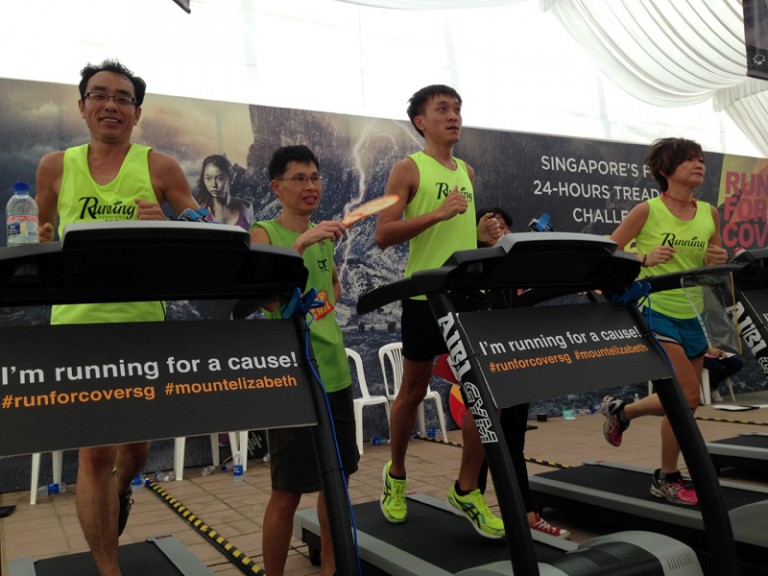
Last weekend, 10 teams consisting of of eight runners each, took turns and pounded the treadmill at the Ngee Ann City Civic Plaza. This was because they were all taking part in the Run for Cover event – a 24-hour treadmill endurance challenge.

Within the 24 hours, the ten teams had to clock the most mileage on the treadmill, in order to walk away with the top prize – 10 years of free health insurance by the race organiser, the Mount Elizabeth Hospital.

The winner of the challenge was the DTCC team, comprising of NUS students and alumni. They chalked up almost 319 kilometres on the treadmill, with each member taking turns to do half-hour sessions.

MR25 came second with about 305 kilometres and Team Tze Char rounded off the top three with just over 292 kilometres clocked on the treadmill.

The Sweltering Heat

For most of the runners, the sweltering heat proved to be their biggest obstacle. Temperatures easily reached up to more than 30 degrees C, so runners had to continuously fan and mist each other, in order to stay cool. At the same time, having constant hydration was also very important.

Fortunately, the race organisers had foreseen this though and there was more than enough isotonic drinks and water to cater to the thirsty and exhausted runners.

DTCC team: The winners of the challenge
DTCC team: The winner of the challenge

Running For A Cause

But the charity component definitely helped to keep the runners going despite the difficulties.

This is because with every 30km clocked in this challenge, a needy person would receive a free cataract surgery. Knowing that they were running not just for themselves, but also clocking the miles to help someone else, definitely helped to spur runners on.

Public Treadmills

As well, public treadmills were also provided at the event and passers-by could jump on and contribute their miles to the cause as well.

This definitely proved to be very popular and these public treadmills were constantly in operation throughout the whole 24 hours. In fact, they were so well received that I found it hard to book a slot myself during the challenge, but I was fortunate and managed to contribute about half an hour of mileage to the cataract surgeries.

A total of 3,500 kilometres were clocked altogether. This was by both the participants and members of the public.

Click here to read more about the Run For Cover treadmill challenge.

Race Review: MR25 X-Country Marathon

10500264_781257481915249_5075191156234740507_n

Actually it’s more of a ‘first half of the x-country marathon‘ race review, since I was the 1st member of a relay team with a colleague from work.

This was a great event. Very small in comparison to other Singapore’s road race, there were maybe 500-800 runners in total.

I’ve recently started training with the F1 Runners club, so I met the team at the amenity centre around 0630 for a quick warm up.

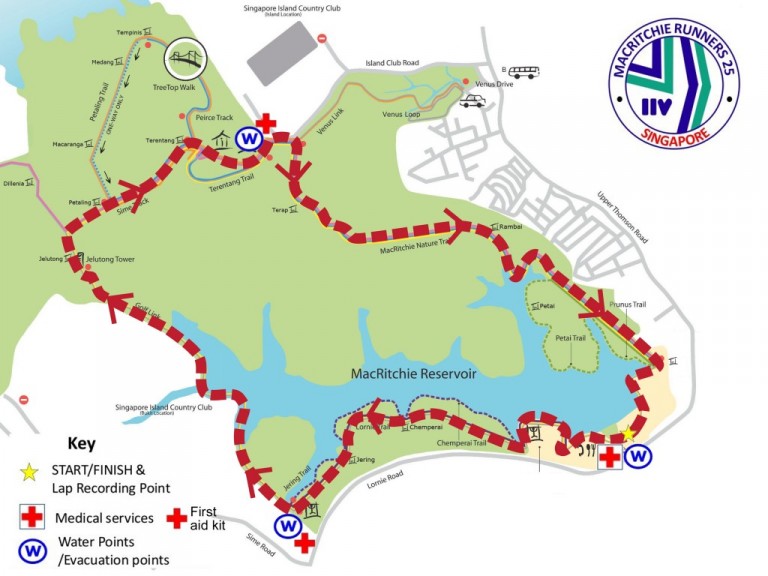
The route was to be an anticlockwise loop of the reservoir, 2 laps each for the relay teams, 4 laps for the full marathoners.

I don’t know about you, but I always run Macritchie clockwise!

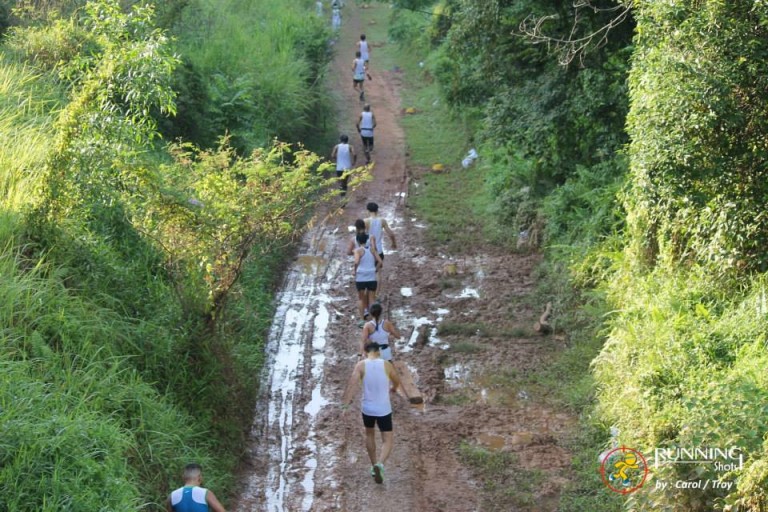
Just as Jacek was giving his Race Director’s speech, a thunderstorm began – which lasted my entire first lap! The trail was flooded in many parts – but having been brought up running cross country in Wales, I am used to a bit of rain – actually I prefer to run in the rain even now.

All dried out by my second lap – it’s amazing how well the trail drains. The last 5k was a good old fashioned bit of racing with another F1 runner – I was able to hold him off with my goat like down hill running skills.

I handed over to Inge, my relay team mate and headed home for a shower. Returned at 1130 to see her come through the finish and collect our medals and very bright finisher T’s!.

10464016_10152451971920255_1655206309232541896_n

mr25x-c2014route (1)

Another awesome Singapore Trail race, can’t wait for The North Face 100 in October.

Happy Running guys….