

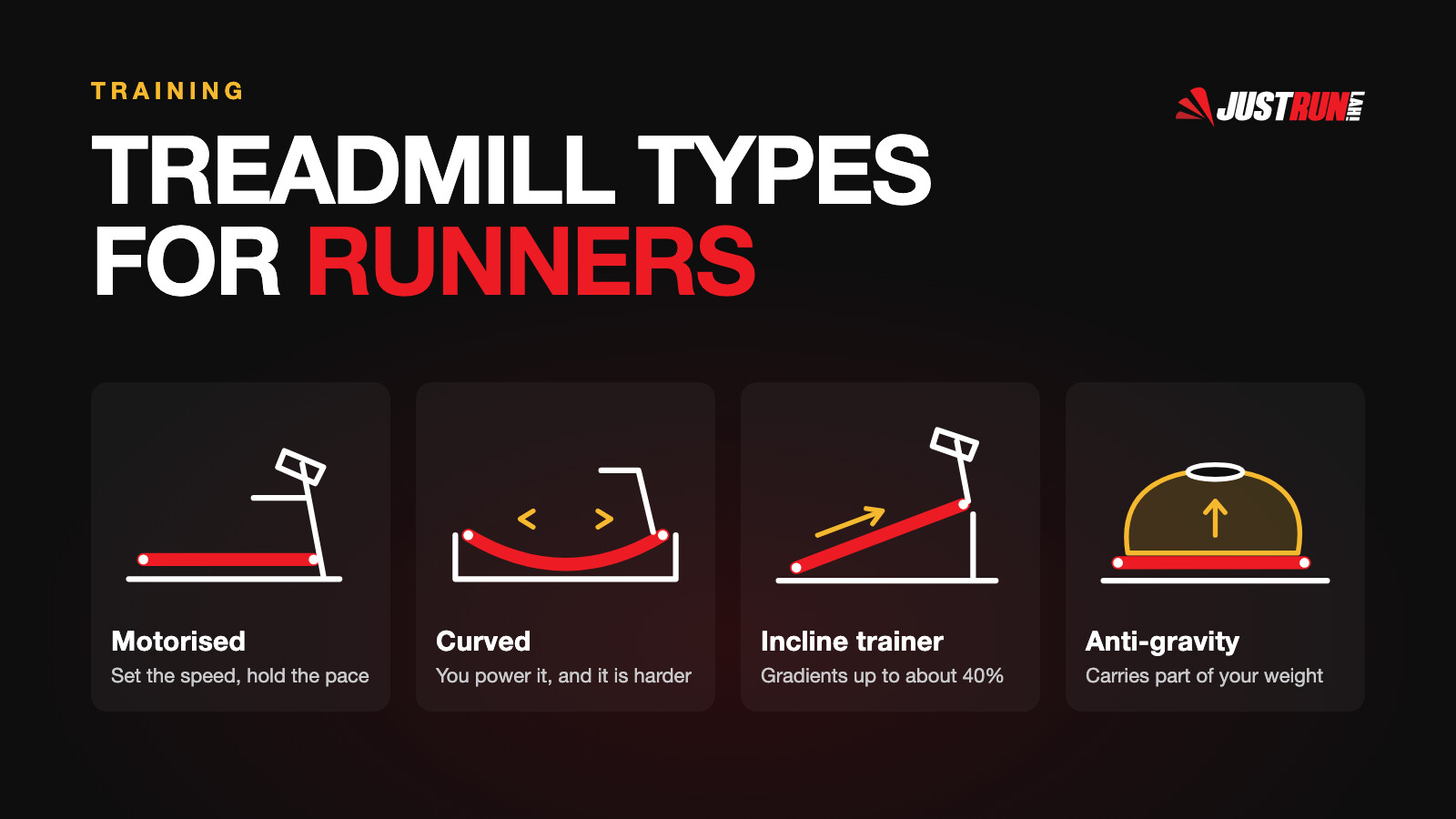
Heat or downpours push many runners indoors for part of the week. The machine waiting there is no longer always the same one. Next to the familiar motorised treadmill, many gyms now have curved, self-powered treadmills, steep incline trainers and, in some clinics, treadmills that carry part of your body weight. They train different things, and the same speed does not mean the same effort on each. Here is what each type does and when to use it.
In this article
Treadmill types at a glance
| Type | What moves the belt | Best for | Keep in mind |
|---|---|---|---|
| Motorised (flat belt) | A motor, at the speed you set | Easy runs, tempo runs, long runs, controlled intervals | Set 0–1% incline to match outdoor effort |
| Curved, non-motorised | Your legs | Sprints, short intervals, running form | Clearly harder at the same speed |
| Incline trainer | A motor, with gradients up to about 40% | Hill and trail preparation | Calf and Achilles load builds quickly |
| Anti-gravity (body-weight support) | A motor, with air pressure lifting part of your weight | Returning from injury, extra volume with less impact | Found in physio and sports clinics, usually paid per session |
| Folding home treadmill or walking pad | A small motor | Walking, easy jogging at home | Check top speed and belt length before you buy |
1. The motorised treadmill
This is the standard gym treadmill. You choose a speed and a gradient, and the belt holds them until you change them. That makes it the best tool for sessions where pace control matters, such as tempo runs, progression runs and long intervals.
Does it match running outside? Largely, yes. A review of 33 studies found that running mechanics on a motorised treadmill are mostly comparable to running overground, with small differences in how the foot lands [3]. A second review of 34 studies found similar oxygen use at easy and moderate speeds, but poorer endurance performance on the treadmill than outdoors [2]. In other words, the same pace costs about the same energy, yet a hard effort often feels tougher indoors. Heat build-up and boredom are the usual suspects, so use the fan.
The 1% rule. Indoors there is no air resistance. A classic study found that a 1% gradient best matched the energy cost of outdoor running at speeds between about 10.5 and 18 km/h [1]. At slower speeds a flat belt was just as close. So set 1% for steady and fast running, and do not worry about it for an easy jog.
Treadmills show speed in km/h, while most runners think in minutes per km. As a quick guide, 10 km/h is 6:00 per km, 12 km/h is 5:00 per km and 15 km/h is 4:00 per km. Our pace calculator converts any other value. For session ideas, see 4 Treadmill Training Tips Every Runner Needs.
2. The curved, non-motorised treadmill
These are the machines with a curved running surface and no motor, often seen in CrossFit boxes, HYROX-style classes and performance gyms. The AssaultRunner, Woodway Curve and TrueForm Runner are well-known examples. The belt is a band of slats on bearings, and it only moves when you push it. Step further up the curve and it speeds up. Drift back and it slows down. There is no top speed and no button to press, which makes it ideal for sprints and short intervals where a motorised belt takes too long to change speed.
It is harder, and by a measurable amount.
- In a study of 14 trained runners, running at the same speed on a curved treadmill used 22% more oxygen than running overground and 16% more than on a motorised treadmill. Heart rate was about 22–25 beats per minute higher [4].
- The gap was larger for lighter runners [4].
- Another study matched it against a motorised treadmill at different gradients. At 10 km/h, the curved treadmill felt and cost about the same as running up a 6–8% slope [5].
What that means for you: do not copy your usual treadmill pace onto a curved one. Run by effort or heart rate, expect to be noticeably slower for the same feeling, and keep the first sessions short. Use it for strides, 20–60 second sprints and short hill-like repeats. For a 15 km steady run, the motorised treadmill is the better choice.
3. The incline trainer
A normal gym treadmill usually tilts to 10–15%. Incline trainers go much further, up to about 40% on some models, and a few can also tilt slightly downhill. For runners in a flat city, this is the easiest way to prepare for a hilly road race or a trail event: long steady climbs at hiking or slow running speed, with no traffic lights.
Build up gradually, because steep gradients load the calves and Achilles tendons much more than flat running. Keep your hands off the rails, or the gradient stops doing its job. Downhill running needs its own practice, which we cover in Running Downhills: What You Need to Know, and there is a full session in Training for the Mountain: A Trail Running Workout.
4. The anti-gravity treadmill
An anti-gravity treadmill seals your lower body inside an air chamber. Raising the air pressure lifts you slightly, so you can run at a chosen share of your body weight. Research on this design shows that weight support lowers both the forces through the legs and the energy needed to run, and that running faster with support can give the same aerobic work as running slower at full weight, with lower peak forces [6].
That is why these machines are used for returning to running after injury, and by some marathoners to add volume with less impact. You will find them mostly in physiotherapy and sports medicine clinics. If you are coming back from an injury, use one under the guidance of your physiotherapist.
5. Home treadmills and walking pads
Folding treadmills and slim under-desk walking pads have become popular for small flats. They are good for walking and light jogging, but many are not built for running. Before buying, check four things: the top speed (many walking pads stop at around 6 km/h), the belt length and width against your stride, the maximum user weight, and whether it has any incline at all. Our older guide, How to Choose a Treadmill for Your Home, goes through the basics.
Which treadmill for which session?
| Session | Best choice | How to set it |
|---|---|---|
| Easy or recovery run | Motorised | 0–1%, a pace at which you can talk |
| Tempo or marathon-pace run | Motorised | 1%, target pace in km/h |
| Sprints and short intervals | Curved, non-motorised | By effort, with full recovery between repeats |
| Hill or trail preparation | Incline trainer | Start at 8–10% and build up over weeks |
| Return from injury | Anti-gravity | As set by your physiotherapist |
Five tips that apply to all of them
- Do not trust the display blindly. Belt speed varies from machine to machine. Use effort and heart rate as a second check.
- Cool yourself. There is no headwind indoors. Stand near a fan and drink as you would outside. See 7 Smart Ways to Rehydrate Faster.
- Let go of the handrails. Holding on changes your posture and lowers the workload.
- Change one thing at a time. A new type of treadmill is a new load on your legs. Start with a short session.
- Keep some running outdoors. Race day comes with heat, corners and uneven ground. Our tips for training in a hot and humid climate and for training during haze season help you decide when to stay in and when to go out.
Where to try them
Almost every gym has motorised treadmills. Curved treadmills are common in functional-fitness and performance gyms, and incline trainers and anti-gravity treadmills are rarer. Browse our Singapore gyms directory and ask about the equipment before you sign up or book a trial. Then put the fitness to use: pick your next event in the running events calendar.
References
- Jones AM, Doust JH. A 1% treadmill grade most accurately reflects the energetic cost of outdoor running. Journal of Sports Sciences, 1996.
- Miller JR, Van Hooren B, Bishop C, et al. A Systematic Review and Meta-Analysis of Crossover Studies Comparing Physiological, Perceptual and Performance Measures Between Treadmill and Overground Running. Sports Medicine, 2019.
- Van Hooren B, Fuller JT, Buckley JD, et al. Is Motorized Treadmill Running Biomechanically Comparable to Overground Running? Sports Medicine, 2020.
- Edwards RB, Tofari PJ, Cormack SJ, Whyte DG. Non-motorized Treadmill Running Is Associated with Higher Cardiometabolic Demands Compared with Overground and Motorized Treadmill Running. Frontiers in Physiology, 2017.
- Schoenmakers PPJM, Crisell JJ, Reed KE. Physiological and Perceptual Demands of Running on a Curved Nonmotorized Treadmill Compared With Running on a Motorized Treadmill Set at Different Grades. Journal of Strength and Conditioning Research, 2020.
- Grabowski AM, Kram R. Effects of velocity and weight support on ground reaction forces and metabolic power during running. Journal of Applied Biomechanics, 2008.


Comments