

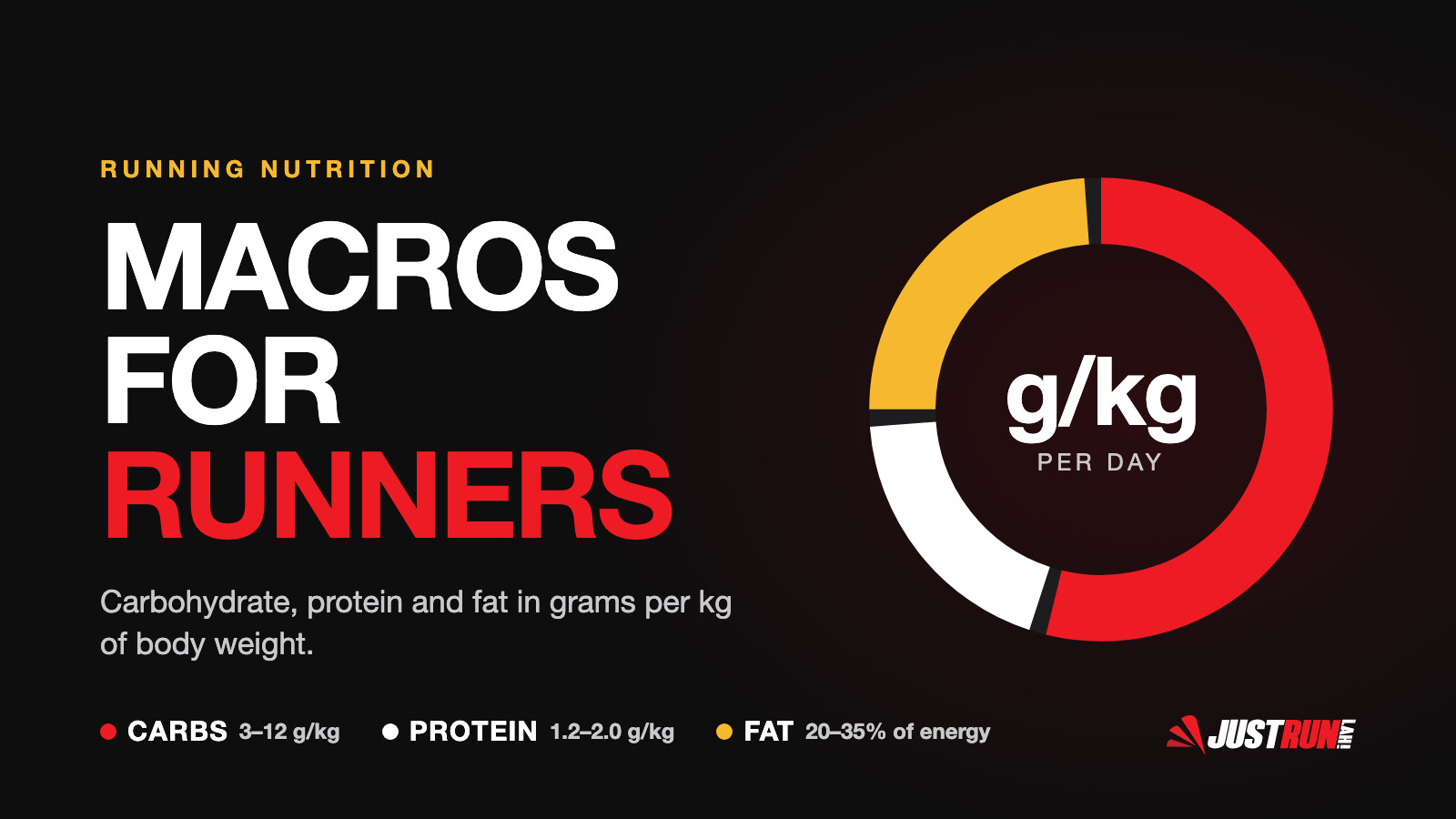
Most runners know they should “eat enough carbs” and “get some protein after a run”. Fewer know what that means in grams. Sports nutrition guidelines are written per kilogram of body weight, which makes them easy to turn into numbers for your own week. This guide does that for carbohydrate, protein and fat, and then shows how to use those numbers when you choose a protein bar, a shake or a plain plate of food.
In this article
The three macros, in one line each
- Carbohydrate is your main fuel for anything faster than an easy jog. The amount you need rises and falls with your training.
- Protein repairs muscle after training. The amount you need depends on your body weight, and much less on your mileage.
- Fat covers the rest of your energy needs and carries vitamins A, D, E and K. It should not drop too low.
For the wider picture, including vitamins and minerals, see Macro and Micro Nutrients: The Essential Elements of a Runner’s Diet.
Carbohydrate: match it to your training day
The joint position stand of the American College of Sports Medicine, the Academy of Nutrition and Dietetics and Dietitians of Canada gives daily carbohydrate targets by training load [1]:
| Training day | Carbohydrate per kg of body weight | For a 60 kg runner |
|---|---|---|
| Rest day or short easy jog | 3–5 g | 180–300 g |
| About 1 hour of moderate running | 5–7 g | 300–420 g |
| 1–3 hours, marathon training block | 6–10 g | 360–600 g |
| More than 4–5 hours (ultra training) | 8–12 g | 480–720 g |
The point is that carbohydrate is not a fixed number. A rest day and a 30 km long-run day should not look the same on your plate.
Before, during and after a run
- Before: 1–4 g of carbohydrate per kg, eaten 1–4 hours before a long run or race [1]. Keep this meal low in fat and fibre so it sits well.
- During: runs under 45 minutes need nothing. From 1 to 2.5 hours, aim for 30–60 g of carbohydrate per hour. Beyond 2.5 hours, up to 90 g per hour from a mix of glucose and fructose sources [2] [3]. Practise this in training, never for the first time on race day.
- After: if you train again within 8 hours, take 1–1.2 g per kg per hour for the first 4 hours [1]. If your next run is tomorrow evening, normal meals will refill you. More on this in Should You Eat Carbs After Your Run?
- Race week: for events longer than 90 minutes, 10–12 g per kg per day in the last 36–48 hours tops up your stores [1]. We go through the days before a race in What To Eat The Week Of Your Marathon?
Protein: steady, every day
The same position stand puts protein for athletes at 1.2–2.0 g per kg of body weight per day [1]. The International Society of Sports Nutrition gives a similar 1.4–2.0 g per kg [4]. Both agree on how to spread it: about 0.25–0.3 g per kg per meal (roughly 20–40 g for most adults), every 3–4 hours, including once soon after training.
| Body weight | Protein per day (1.2–2.0 g/kg) | Protein per meal (0.25–0.3 g/kg) |
|---|---|---|
| 55 kg | 66–110 g | 14–17 g |
| 65 kg | 78–130 g | 16–20 g |
| 75 kg | 90–150 g | 19–23 g |
Unlike carbohydrate, this target stays the same on rest days. Recovery happens on the days you do not run. Protein also does more than repair muscle, as we explain in Think Protein Is Just for Building Muscle? Think Again.
Fat: do not cut it too far
Fat should supply about 20–35% of your daily energy, and the guidelines advise against going below 20% for long periods [1]. The practical rule for runners is about timing. Fat and fibre slow digestion, so keep both low in the last meal before a hard session and enjoy them at other times of the day.
From grams to food: compare by protein per 100 kcal
Once you know you need about 20 g of protein after a run, the next question is what to eat to get it. Serving sizes differ from product to product, so the fair way to compare is per 100 g or per 100 kcal. We covered the label itself in A Runner’s Guide to Reading Nutrition Labels.
MacroXray does this comparison for more than 1,100 protein bars, powders, shakes and snacks. Its main measure is “protein efficiency”, which is grams of protein per 100 kcal. It also ranks products by protein per dollar, protein-to-fat ratio, net carbs and fibre, and the methodology page explains how each score is calculated. The site states that its rankings are not sponsored and that it relies on the nutrition facts published by manufacturers and retailers.
The same measure works for fresh food. MacroXray’s article Protein Powder vs Whole Foods puts everyday foods next to powders, using USDA data for the foods:
| Food | Protein per 100 kcal | Protein per 100 g |
|---|---|---|
| Tuna, canned in water | 22.4 g | 26.0 g |
| Chicken breast, cooked | 18.8 g | 31.0 g |
| Greek yogurt, plain, nonfat | 16.9 g | 10.0 g |
| Tofu, firm | 10.5 g | 8.0 g |
| Whole egg, cooked | 8.4 g | 13.0 g |
| Lentils, cooked | 7.8 g | 9.0 g |
| Peanut butter, natural | 4.3 g | 25.0 g |
Peanut butter is the useful surprise in that table. It has plenty of protein per 100 g, but most of its calories come from fat, so it is a poor way to reach a protein target. For comparison, the top of MacroXray’s protein bar ranking (433 bars at the time of writing) reaches 18.7 g of protein per 100 kcal, about the same as chicken breast, and many well-ranked bars sit near 10–12 g.
Read a protein snack like a runner
Most protein rankings are built for people who lift or who are cutting calories. Runners can use the same data, but should read three of the numbers differently.
- Low carb is not a bonus after a long run. A bar with 28 g of protein and 7 g of carbohydrate is a good protein source, but it will not refill your legs. Pair it with a banana (about 27 g of carbohydrate, USDA [5]), rice or bread.
- Fibre is about timing. Some bars carry more than 20 g of fibre per 100 g. That helps your daily fibre intake and is a bad idea in the hour before intervals. MacroXray has a separate piece on fibre in high-protein products.
- A protein bar is not race fuel. During a run you need fast carbohydrate (gels, sports drink, bananas). Protein, fat and fibre slow things down.
What to reach for, and when
| When | What you want | Examples |
|---|---|---|
| 1–4 hours before | Mostly carbohydrate, low fat and fibre | Rice or noodles with a little lean protein, toast with banana, oats |
| During (over 1 hour) | 30–60 g of fast carbohydrate per hour | Gels, sports drink, banana |
| Within an hour or two after | About 20 g of protein plus carbohydrate | Greek yogurt and fruit, eggs on toast, chicken rice, or a ready-to-drink shake with a banana |
| Between meals | A protein top-up that fits your calories | A bar or snack chosen by protein per 100 kcal, such as those in MacroXray’s high-protein, low-calorie snack ranking |
If breakfast is where your protein falls short, oats are an easy base: mostly carbohydrate, with protein added through milk, yogurt or powder. MacroXray’s protein oats article has the numbers.
A worked example
Take a 65 kg runner on a 90-minute long-run day in a marathon block.
- Carbohydrate: 6–10 g per kg, so 390–650 g across the day.
- Protein: 78–130 g across the day, in four or five portions of 16–20 g or a little more.
- During the run: 30–60 g of carbohydrate per hour, for example one or two gels per hour or a sports drink.
- After the run: a 170 g tub of plain nonfat Greek yogurt gives about 17 g of protein. Add a banana and a bowl of oats or rice for the carbohydrate.
On a rest day the protein stays the same and the carbohydrate drops to the 3–5 g per kg range. For more recovery meal ideas, read The Ultimate Guide to Post-Workout Nutrition.
Key points
- Work in grams per kg of body weight. Percentages hide how much you actually eat.
- Carbohydrate follows your training load. Protein stays steady at 1.2–2.0 g per kg per day.
- Compare foods and snacks by protein per 100 kcal, and check carbohydrate and fibre against the time of day you will eat them.
- Fresh food and packaged snacks both have a place. Chicken, tuna, yogurt, tofu and eggs cover most of your protein, and a bar or shake helps when a meal is not practical.
Planning your next race? Work out your target pace with our pace calculator and find an event in the running events calendar.
This article is general information for healthy adult runners. It is not medical or dietary advice. If you have a medical condition, a history of disordered eating, or are pregnant, speak to a doctor or a registered dietitian before changing your diet.
References
- Thomas DT, Erdman KA, Burke LM. Nutrition and Athletic Performance. Joint position statement of the American College of Sports Medicine, the Academy of Nutrition and Dietetics and Dietitians of Canada. Medicine & Science in Sports & Exercise, 2016.
- Burke LM, Hawley JA, Wong SHS, Jeukendrup AE. Carbohydrates for training and competition. Journal of Sports Sciences, 2011.
- Jeukendrup A. A step towards personalized sports nutrition: carbohydrate intake during exercise. Sports Medicine, 2014.
- Jäger R, Kerksick CM, Campbell BI, et al. International Society of Sports Nutrition Position Stand: protein and exercise. Journal of the International Society of Sports Nutrition, 2017.
- U.S. Department of Agriculture. FoodData Central.
- MacroXray (macroxray.com). Methodology, and “Protein Powder vs Whole Foods”, both linked above. Product figures as shown in November 2026.




Comments