


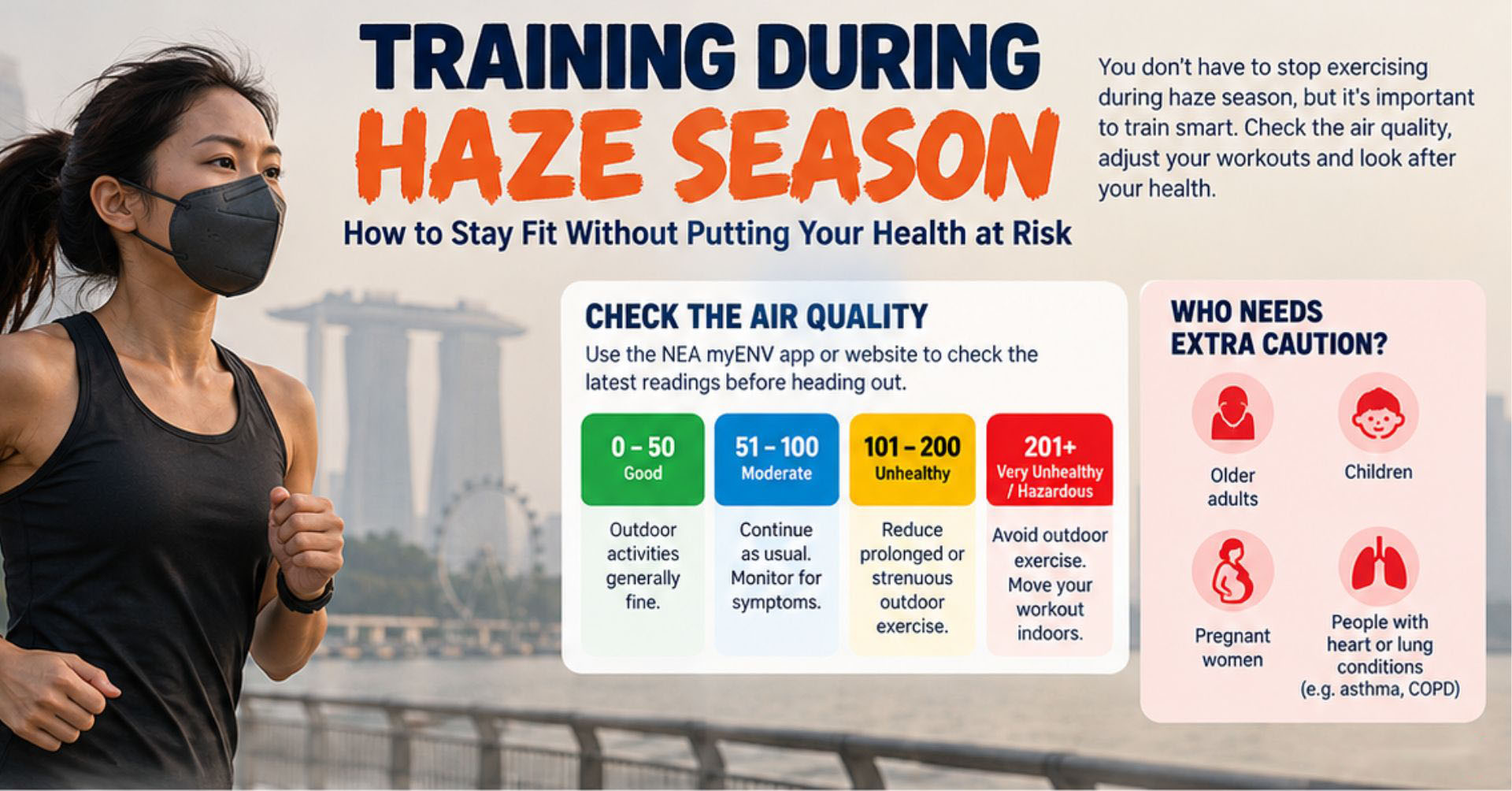
For runners chasing a marathon personal best, HYROX athletes preparing for race day, or fitness enthusiasts trying to stay consistent, haze season can disrupt even the best training plans.
When the air becomes hazy, should you skip your workout, move indoors or carry on as usual? And how much should you worry about the health effects of exercising in polluted air?
The good news is that haze does not necessarily mean you have to stop exercising altogether. The key is to understand the air quality, adjust the intensity and location of your workouts, and recognise when your body needs a break.
Here is how to manage your training safely during haze season without losing sight of your fitness goals.
1. Understand how haze affects your body
Haze contains fine particles and other pollutants produced by sources such as forest fires. Fine particulate matter, particularly PM2.5, is a concern because these tiny particles can travel deep into the respiratory system.
During exercise, your breathing becomes faster and deeper. This means you may inhale more polluted air than you would while resting, especially during prolonged or high-intensity sessions.
For healthy individuals, short-term exposure may cause temporary irritation of the eyes, nose, throat and skin. Haze can also aggravate existing respiratory conditions, including asthma and chronic obstructive pulmonary disease (COPD). People with heart disease may be at increased risk of cardiovascular complications during significant pollution episodes.
Potential symptoms include:
- Dry or irritated throat
- Coughing and sneezing
- Watery, itchy or irritated eyes
- Runny or blocked nose
- Wheezing or shortness of breath
- Chest tightness or unusual discomfort
Not everyone reacts to haze in the same way. Symptoms can also appear after exposure rather than immediately, so feeling fine during a workout does not necessarily mean the exposure had no effect.
2. Check the air quality before every workout
Before heading out for a run, outdoor gym session or HYROX simulation, check the latest air quality information rather than relying on how clear the sky looks.
In Singapore, two useful indicators are:
The 24-hour Pollutant Standards Index (PSI) helps you plan activities for the day ahead. A reading of 101 or above is classified as unhealthy.
The one-hour PM2.5 reading provides a more immediate indication of fine-particle pollution and can help guide decisions about outdoor activities in the near term.
Check the NEA’s haze advisories or use the myENV app before exercising.
Singapore’s general health guidance varies according to air quality and individual health status. When the 24-hour PSI reaches the unhealthy range, healthy people should reduce prolonged or strenuous outdoor physical exertion. Older adults, pregnant women, children, and people with chronic heart or lung conditions should take greater precautions.
Remember that a single reading is not a guarantee of safety. Conditions can change during the day, and your own symptoms matter too.
3. How runners should adjust marathon training
Marathon preparation relies on consistency, with long runs, tempo sessions and intervals playing different roles. However, haze is a good reason to temporarily modify the plan.
Easy runs and recovery runs
If air quality is acceptable and you feel well, an easy run may still be appropriate. However, when pollution rises, consider moving your run indoors or replacing it with a low-intensity indoor session.
Do not assume that running at a slower pace completely removes the risk. Duration matters too, and a long easy run can still involve substantial exposure.
Long runs
Long runs deserve particular attention because they involve prolonged outdoor exposure. If air quality is unhealthy, move the session indoors, shorten it substantially or postpone it until conditions improve.
Missing one long run is generally less damaging to your marathon preparation than repeatedly exposing yourself to polluted air or becoming unwell.
Tempo runs and intervals
Fast intervals, threshold runs and marathon-pace workouts require heavier breathing. These sessions are best moved to a suitable indoor environment when outdoor pollution is elevated.
A treadmill session can help preserve the training stimulus. If you cannot access a suitable indoor facility, consider postponing the workout rather than forcing it into poor conditions.
Marathon tip: Do not try to make up every missed kilometre once the haze clears. Resume your schedule sensibly and avoid cramming several demanding sessions into a short period.
4. How HYROX athletes should adapt their training
HYROX combines running with demanding functional stations such as sled pushes and pulls, burpee broad jumps, rowing, farmers’ carries and wall balls. Many athletes train at high intensity, making air quality particularly relevant.
During haze season, consider the following adjustments.
Move outdoor running indoors. Replace outdoor intervals or compromised running sessions with treadmill work when the indoor air quality is suitable.
Modify high-intensity circuits. Instead of an all-out simulation, perform controlled strength work, technique drills or lower-intensity aerobic training. Avoid pushing through coughing, chest tightness or unusual breathlessness.
Separate strength and conditioning where necessary. A strength-focused session with adequate rest may be more manageable than a continuous circuit that drives up your breathing rate. However, heavy lifting still creates physical strain, so scale the workout according to how you feel and the advice applicable to your health status.
Prioritise movement quality. Use the opportunity to refine sled technique, wall-ball mechanics, rowing efficiency and transitions without chasing personal records.
If your HYROX race is approaching, it can be tempting to complete every planned simulation. Resist that urge when conditions are poor. One modified session will not erase months of preparation.
5. Can you continue working out in a gym?
Moving indoors can reduce exposure to outdoor haze, but indoor exercise is not automatically risk-free. Smoke particles may enter buildings, and indoor air quality depends on ventilation, filtration and the building’s conditions.
If you choose a gym or fitness studio:
- Prefer a clean-air indoor environment with effective filtration.
- Check whether the facility has appropriate air filtration and maintenance.
- Avoid opening doors and windows when outdoor haze is particularly heavy, if this would allow more polluted air inside.
- Reduce intensity if you develop respiratory symptoms or feel unusually fatigued.
If indoor conditions are poor too, take a rest day or choose gentle movement in a cleaner environment instead.
You can maintain your routine with mobility work, stretching, controlled strength exercises or light indoor activity. The goal is to stay active without turning every workout into a test of endurance.
6. What about wearing an N95 mask while exercising?
A properly fitted N95 mask can reduce inhalation of fine particles when worn correctly. However, it can also make breathing feel more difficult during exertion, and it should not be treated as a way to make a hard outdoor workout safe during severe haze.
Singapore MOH does not generally recommend N95 masks for short exposures, such as routine commuting, or for indoor environments. For healthy individuals who must spend several hours outdoors when air quality is hazardous, an N95 mask may help reduce exposure. Vulnerable individuals should follow the specific health advice applicable to them.
For training purposes, the better approach is to avoid strenuous outdoor exercise when advisories recommend reducing or avoiding it, rather than relying on a mask to continue at full intensity.
7. Health advice: hydration, recovery and medical warning signs
Haze can irritate your throat and airways, so drink water regularly and maintain your usual hydration routine. In Singapore’s hot and humid weather, this is especially important if you are still exercising.
However, hydration does not neutralise inhaled pollutants. It is not a substitute for reducing exposure.
Get sufficient sleep and allow yourself extra recovery if you feel unwell. Do not interpret unusual fatigue or a decline in performance as a challenge to push harder.
When should you stop exercising?
Stop your session and move to a cleaner environment if you develop:
- Persistent coughing or worsening throat irritation
- Wheezing or unusual shortness of breath
- Chest tightness or discomfort
- Dizziness or feeling faint
- A sudden, unexplained drop in exercise tolerance
Seek medical advice if symptoms persist, worsen or recur, particularly if you have asthma or an existing heart or lung condition.
Seek urgent medical attention for severe breathing difficulty, significant chest pain, fainting or other serious symptoms. Do not attempt to run or train through these warning signs.
People with asthma should follow their prescribed asthma action plan and keep their medication available. Those with chronic heart or lung conditions should consult their healthcare professional about appropriate activity levels during haze episodes.
8. How to stay fit without losing momentum
Haze season is a reminder that training plans should be flexible. Fitness improves through months of consistent work, not by completing every workout regardless of conditions.
Try these simple strategies:
- Have an indoor alternative: Prepare a treadmill session, indoor bike workout or strength routine for days when outdoor air quality deteriorates.
- Keep easy days easy: Do not replace every missed run with a hard indoor workout.
- Be flexible with key sessions: Reschedule important workouts when conditions improve, provided there is enough recovery time.
- Track symptoms, not just performance: Pay attention to how you breathe and feel during and after exercise.
- Follow official advisories: Use the latest PSI and PM2.5 readings rather than relying on appearance or smell alone.
If your race is near, remember that arriving healthy and well-rested is more valuable than squeezing in one extra session. A short reduction in training volume is usually manageable; illness or an exacerbation of an existing condition can have a much greater impact.
The bottom line
Whether you are preparing for a marathon, training for HYROX or simply trying to stay fit, haze season calls for smart adjustments rather than blind consistency.
Check air quality before exercising, move demanding workouts indoors when appropriate, reduce or avoid outdoor exertion when advisories call for it, and take symptoms seriously.
Your fitness journey is a long-term commitment. Protecting your lungs and heart is part of being a stronger, healthier athlete—not a step backwards.
Train smart, stay flexible and remember: sometimes the best workout decision is knowing when not to push.
Disclaimer: This article provides general health information and is not a substitute for professional medical advice. Follow the latest local health advisories and consult a healthcare professional if you have an underlying condition or develop concerning symptoms.