



A Runner’s Guide to Reading Nutrition Labels
You’ve put the work into your training plan, built up your weekly mileage, and mapped out your favourite routes. But when you pick up a tub of protein powder or a box of energy bars, the wall of numbers on the back can feel overwhelming. The good news is that once you know where to look, reading a nutrition label becomes quick and intuitive — and it can make a real difference to your recovery, your energy levels, and how your body handles training over the long term.
This guide walks through what to focus on, what you can safely skip, and how to compare products without needing a nutrition degree.
Start With Serving Size
Before looking at any other number, check the serving size. This is where labels can be misleading. One protein bar might list its stats per bar, while another lists them per half bar. One powder uses a 25g scoop, another a 40g scoop — naturally the bigger scoop shows a higher protein number.
The simplest fix: always compare products per 100g or per 100 kcal. This puts everything on equal footing. The FDA’s guide to reading nutrition labels covers the regulatory basics well, but as runners we need to look a bit deeper.
The Numbers That Matter Most for Runners
Not every line on a nutrition label carries the same weight when you’re running 30, 50, or 80+ kilometres a week. Here’s where to put your attention.
Protein Efficiency
You already know protein is important for recovery. But the raw gram count can be misleading. What really matters is how much protein you’re getting relative to the calories you’re consuming.
A product that gives you 25g of protein for 350 calories is quite different from one that delivers 25g for 120 calories. As a runner, your calorie budget is valuable — you need fuel for training, not filler. Protein per 100 kcal is the metric that cuts through the noise. Research compiled on Examine.com’s protein guide suggests endurance athletes benefit from 1.2–1.6g of protein per kg of bodyweight daily, so making each serving count is well worth the effort.
Carbohydrates
Unlike many diet trends, runners genuinely need carbohydrates. But there’s a meaningful difference between the carbs in a recovery shake and the carbs in a candy bar. Look at the sugar line — if most of the carb content comes from added sugars, you’re more likely to get a spike and crash rather than sustained energy. For a post-run product, some sugar is fine (it helps with glycogen replenishment), but a daily protein supplement shouldn’t be loaded with it.
Net carbs — total carbohydrates minus fibre — gives you a clearer picture of what’s actually hitting your bloodstream.
Fat Content and Leanness
Fat isn’t the enemy, but in a product that’s meant to deliver protein, a high fat content means you’re paying for something you could get more easily from whole foods. A lean protein powder should have minimal fat per serving. The protein-to-fat ratio tells you how clean the product really is.
Fibre
Most people skip right past fibre on a label. But if you’re relying on shakes or bars for a meaningful portion of your daily nutrition during heavy training blocks, fibre content matters. It supports gut health, keeps you full between meals, and contributes to overall diet quality.
Price Per Gram of Protein
This one isn’t on the label itself, but it’s the number that separates a smart purchase from an expensive one. A well-known brand might charge $2.50 per serving for 20g of protein, while a lesser-known option delivers 30g for $1.50. Over a year of daily use, that difference adds up to hundreds of dollars.
Why Ratios Matter More Than Raw Numbers
This is where most label-reading advice stops too early. Knowing that a product has 25g of protein doesn’t tell you much on its own. What matters is how that protein sits in relation to the calories, the fat, the carbs, and the price. It’s the balance between these dimensions that reveals whether a product is a good fit for you.
Think of it like running pace versus distance. Saying “I ran 10 kilometres” is one data point. Saying “I ran 10K at 4:45/km” tells a much richer story. Nutrition labels work the same way — context changes everything.
This is the approach that MacroXray takes, a cool tool that we found. Rather than listing raw numbers, it scores protein products across five dimensions: protein efficiency, value for money, leanness, low carb, and fibre — and visualises the result as a radar chart. You can see a product’s strengths and trade-offs at a glance.
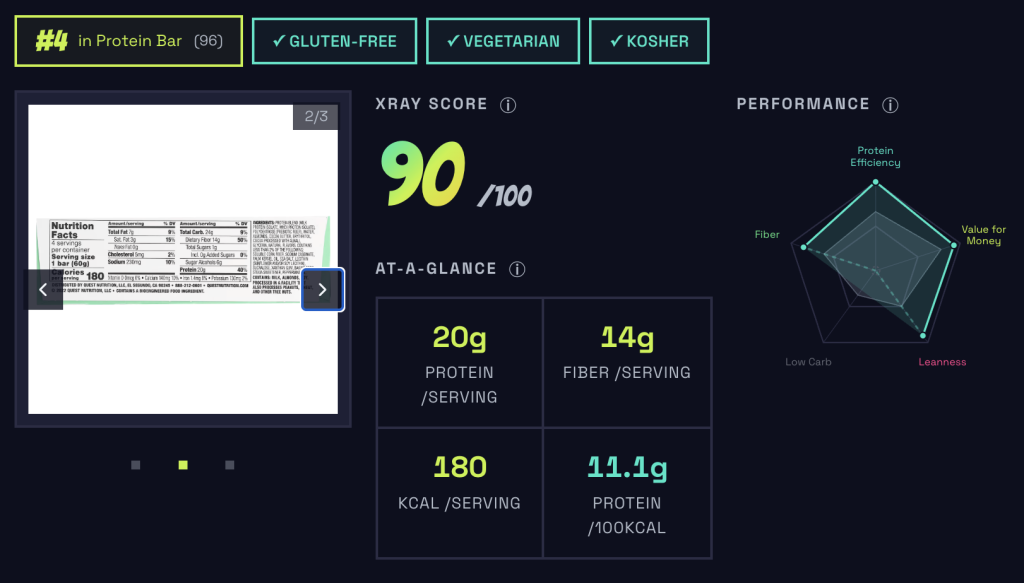
A product that scores well on protein efficiency but poorly on value might not be the right choice for a recreational runner on a budget. The cheapest option might be loaded with fillers. The radar chart makes these trade-offs visible in seconds. You can explore and compare products on MacroXray to see how your current favourite stacks up.
A Quick Label-Reading Checklist
Next time you’re choosing between products run through these checks:
- Normalise the serving size. Compare per 100g or per 100 kcal, not per “scoop” or per “bar.”
- Check protein per calorie. You want strong protein delivery without unnecessary caloric cost.
- Scan the sugar line. Some sugar is fine post-run. Lots of added sugar in a daily supplement is worth questioning.
- Look at the fat ratio. A “protein” product with 12g of fat per serving is really a fat-and-protein product.
- Do the price-per-gram calculation. Or let a tool do it for you — your wallet will appreciate it over a full training cycle.
- Check the ingredient list. Shorter is generally better. If you don’t recognise most of the ingredients, it’s worth looking into them before buying.
Tools That Help
You don’t have to do all the comparison work by hand. A few resources runners find useful:
MyFitnessPal — Helpful for tracking daily intake and seeing how a product fits into your overall nutrition. The barcode scanner is particularly handy when shopping in-store.
Examine.com — The go-to source for evidence-based supplement research. If you want to know whether a specific ingredient actually does what the label claims, start here.
MacroXray — Built specifically for comparing protein products across multiple dimensions at once. The product rankings let you filter and sort by what matters most to you — whether that’s protein efficiency, price, or overall balance. Especially useful when you’re deciding between a few similar options and the labels aren’t making the choice obvious.
The Bottom Line
You wouldn’t enter a race without checking the route. It’s worth giving the same attention to the products that fuel your training. Once you know where to look, a nutrition label becomes a quick and reliable way to make better decisions for your body, your performance, and your budget.
Your legs do the hard work. The least you can do is feed them well.
This article is for informational purposes. For personalised nutrition advice tailored to your training load, consult a registered sports dietitian.